African Fat-Tailed Gecko vs Leopard Gecko: They Look Alike, but Humidity and Temperament Make Them Different Animals
From across the room, a fat-tailed gecko and a leopard gecko look like the same lizard. Same size, same ground-dwelling life, same chunky tail. Which is exactly why people assume "I'll just keep it like a leo," and that assumption is the single most common way fat-tail care goes wrong.
I've never kept a leopard gecko. So this isn't an "I've had both" comparison. It's written by someone who chose the fat-tail, has kept him for four months, and is laying out what turned out to be different from standard leopard gecko care. The leopard gecko side is general husbandry knowledge; the fat-tail side is my own gecko, Ohagi. I'll keep those two clearly separated.
1. Quick comparison table
| African fat-tailed gecko | Leopard gecko | |
|---|---|---|
| Native range | West Africa (semi-arid savanna) | Pakistan to India (arid) |
| Humidity | 60–80% (high) | 30–40% (dry) |
| Warm-side temperature | 86–90°F (30–32°C) | About the same |
| Adult size | About 8 in (20 cm), 50–80 g | About the same, slightly leaner |
| Temperament | Laid-back, slow-moving | More active, some individuals skittish |
| Daytime visibility | Mostly hidden (sometimes just a face) | Comes out now and then |
| Eyes | Look dark and round | Lighter iris, vertical pupil clearly visible |
| Vocal | Almost never | Some individuals chirp |
| Lifespan | 15–20 years | 15–20 years |
| Availability (Japan) | Less common, pricier | Everywhere, huge morph selection |
2. The biggest difference: humidity
If you remember one thing from this page, make it this: leopard geckos like it dry; fat-tails like it damp. Put a fat-tail in a leopard-gecko-style dry tank and his sheds will fail. Skin gets left on the toes, and if nobody notices, he loses the toe.
I mist once a day and use a moist hide (the Japanese ceramic type with a water dish on top), and that keeps the enclosure at 60–70%. With just that, nearly every shed comes off clean. Once, a scrap of skin stayed on a toe; a few minutes in lukewarm water took care of it (the stuck-shed article has photos of the whole thing).
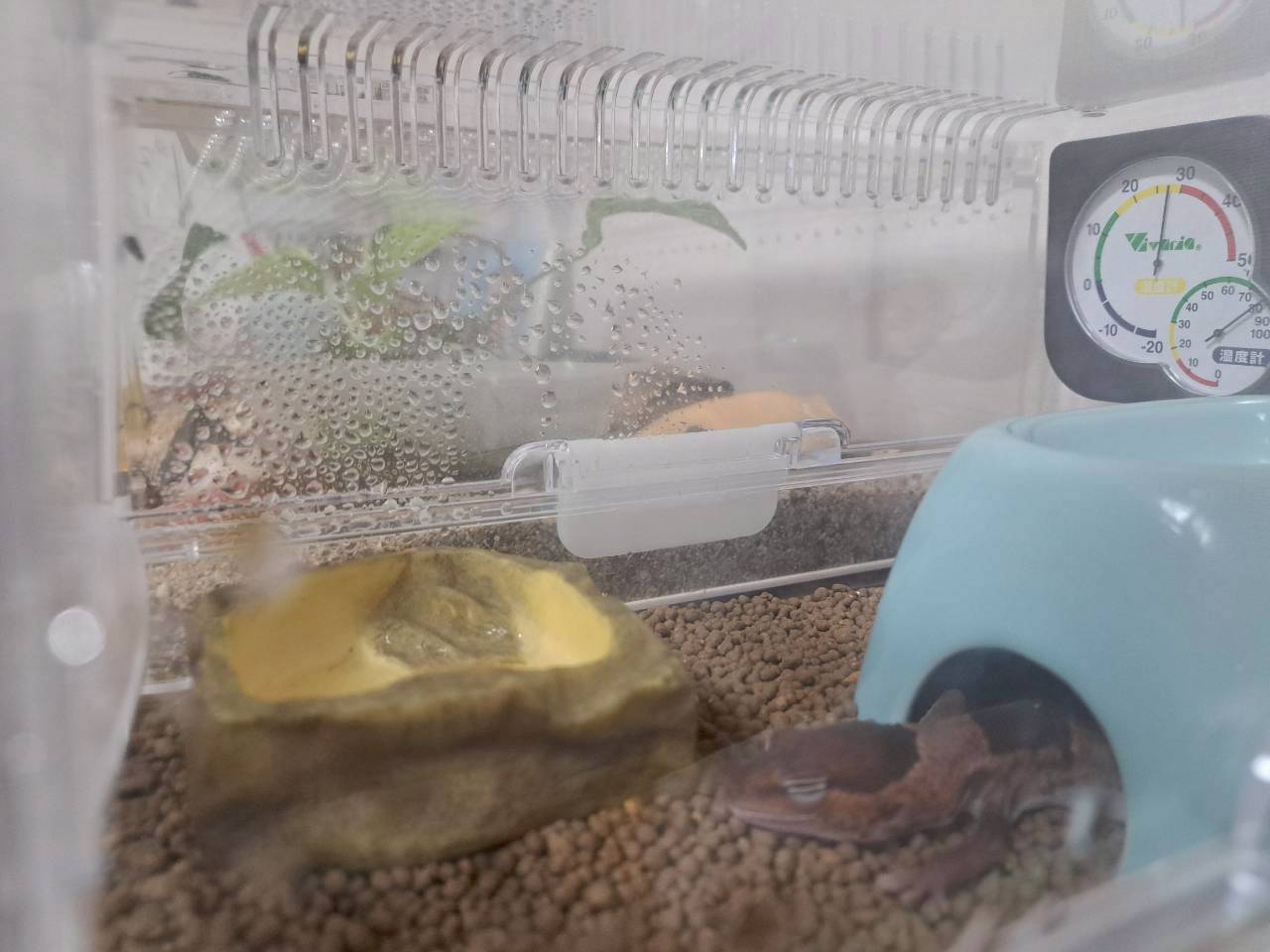
Right after misting. Fogged-up walls are what you want here. To a leopard gecko keeper this probably looks "way too wet"
3. Temperament and movement
Fat-tails are even more laid-back than leopard geckos, and slower. Set him on your hand and he doesn't bolt; he plods. When I open the enclosure, Ohagi comes to the door with a "food?" look, and if I offer a hand he climbs on by himself. He has never bitten me.
The trade-off is that his attachment to his hide is stronger than a leo's. During the day he's almost always inside it, and if you see anything at all it's a face at the entrance. If "I want to watch my pet whenever I like" is high on your list, a leopard gecko suits you better. A fat-tail is an animal you enjoy at night, when you open the door and that face appears.
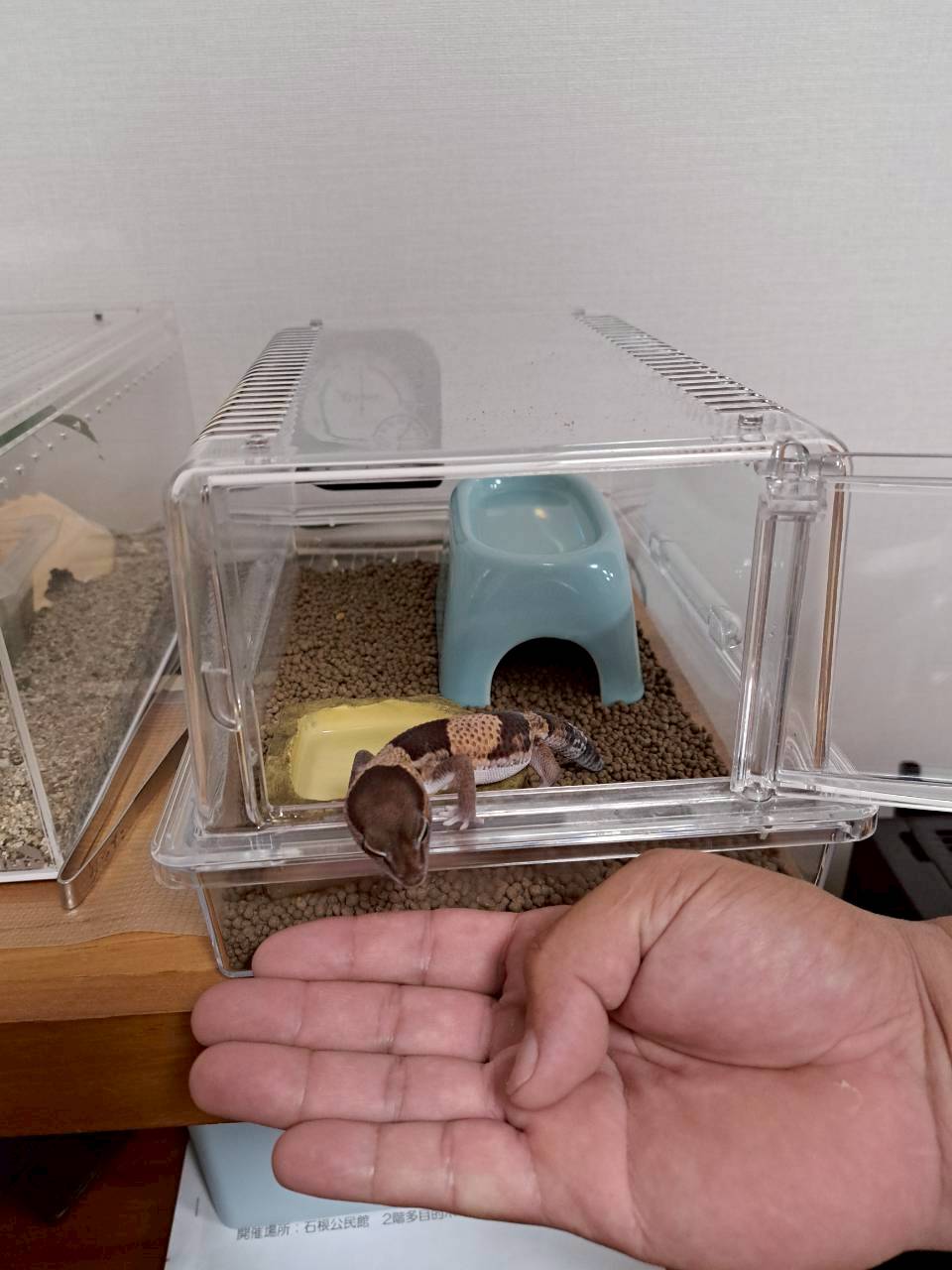
Night, door open. He comes out toward my hand on his own. You'll almost never see this in daylight
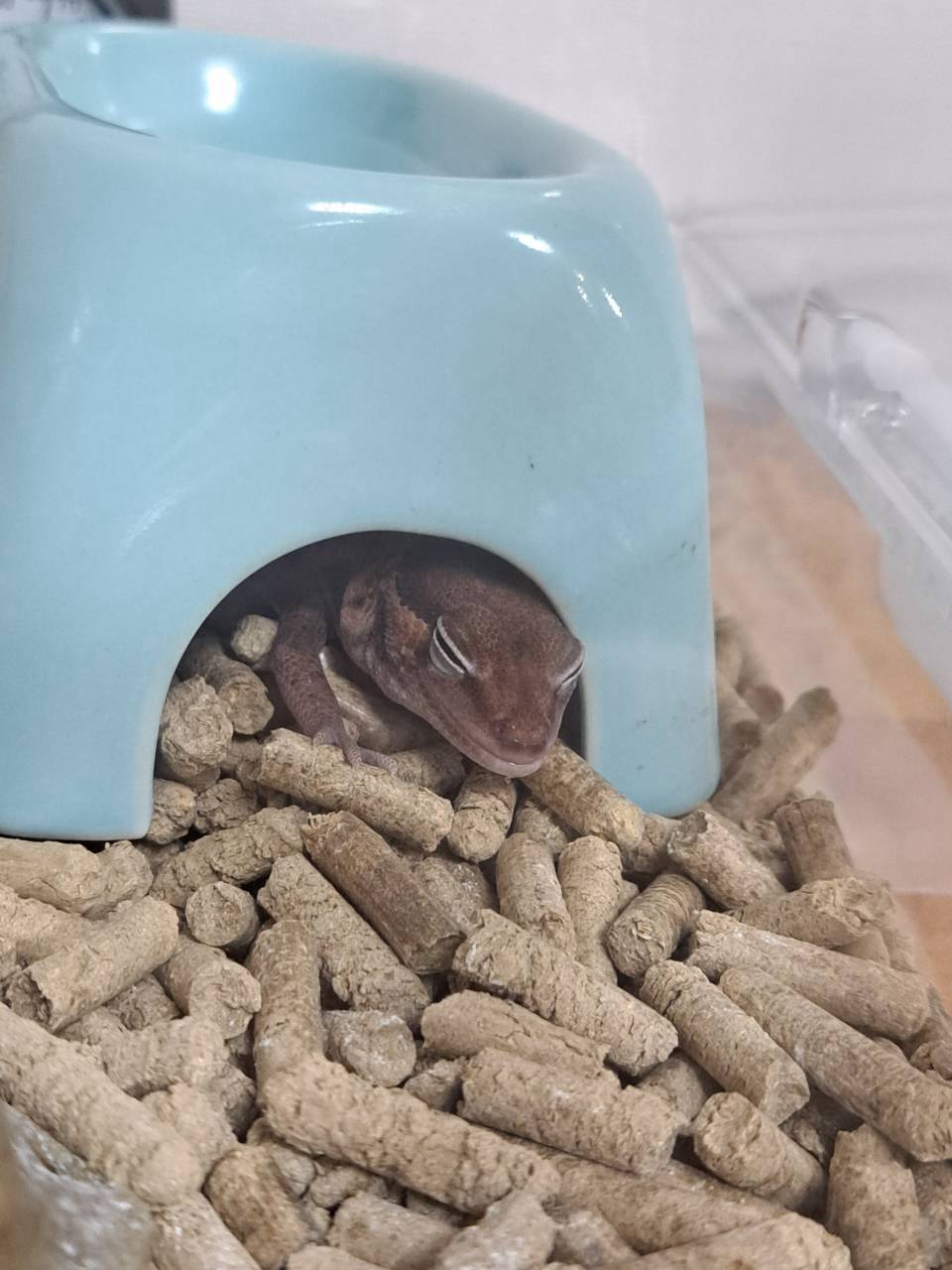
His daytime spot: asleep in the hide. This is normal, not a sign of illness. Sometimes he'll have just his face poking out of the entrance
4. Looks: eyes, tail, build
Before we got him, I was browsing species online and found the leopard gecko's vertical-slit pupil a little off-putting. Fat-tails looked like they had big, round, jet-black eyes, and that sealed it. To be precise, a fat-tail's pupil is a vertical slit too. But the iris is so dark that from any distance you just see a round black eye. A leopard gecko's iris is a lighter color, so the vertical slit stands out.
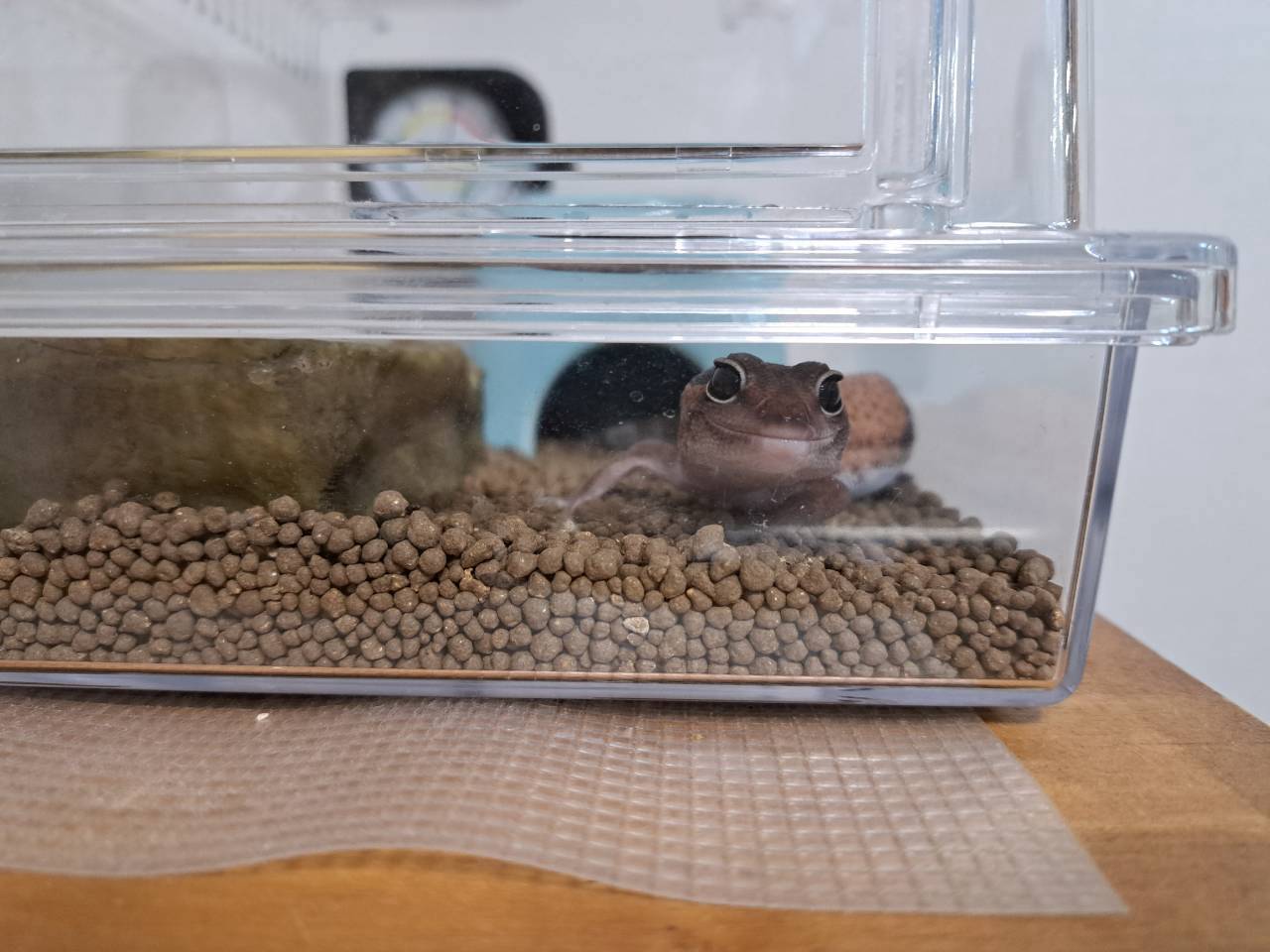
Ohagi's eyes. Dark and round-looking: the fat-tail face
- Tail: thicker on a fat-tail, plump from base to tip. Leopard geckos have a fat tail too, but it's a little sharper.
- Build: fat-tails are rounder and heavier all over. Leos look longer and leaner.
- Pattern: a normal fat-tail has broad brown bands. A normal leopard gecko has black spots on yellow. The fat-tail is the quieter color scheme, and plenty of people prefer it for that.
- Eyelids: both have them (they're both eyelid geckos). Sleeping faces are a shared feature.
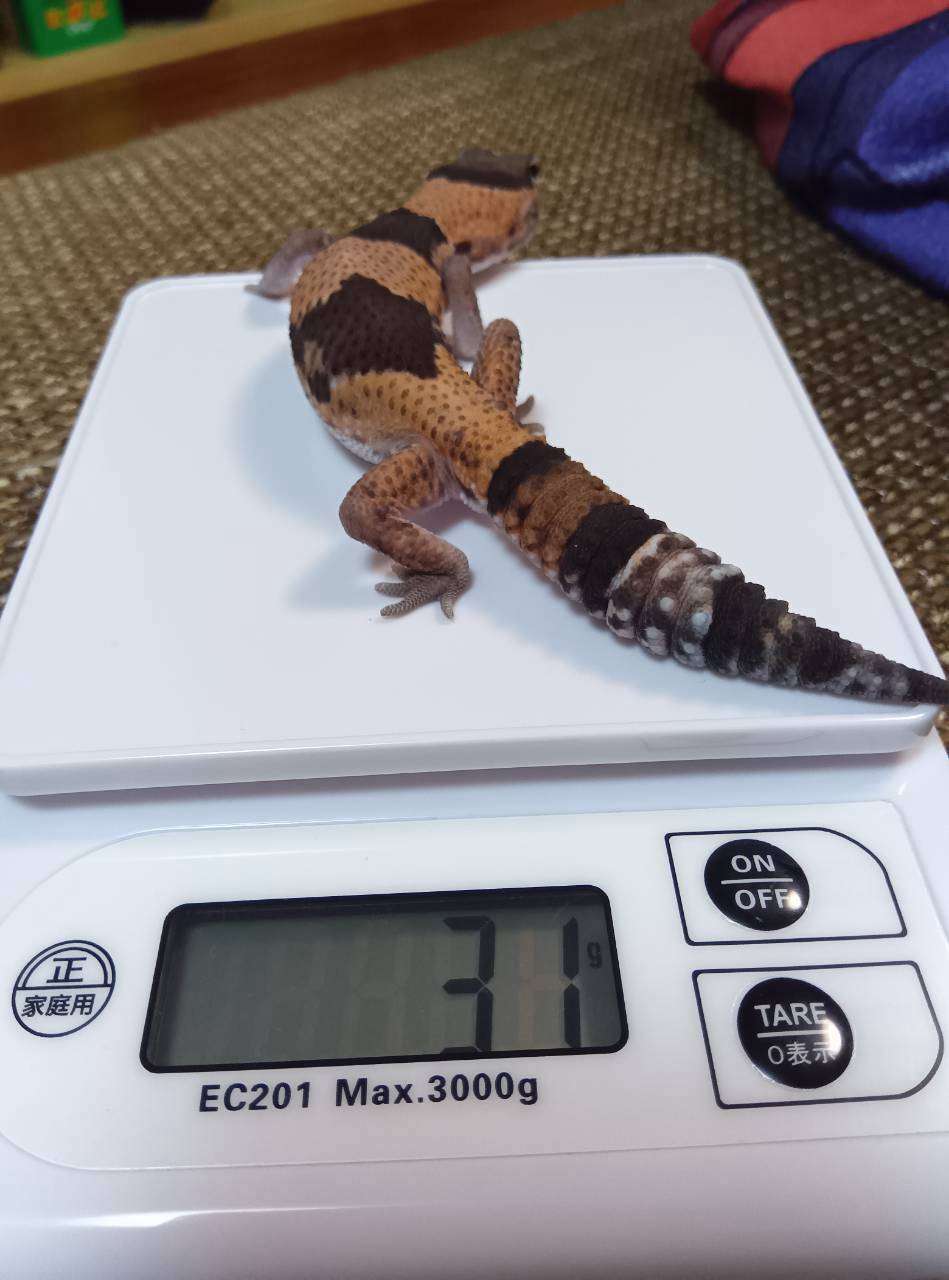
The tail from behind. This thickness is a fat-tail's health gauge
5. Price and availability
In Japan, leopard geckos are everywhere, with a far wider range of morphs and prices. Fewer shops carry fat-tails, and even a "normal" costs more than a normal leo. I picked Ohagi out in person at a reptile shop, and even there they had only a handful of fat-tails.
But fewer of them in the shops doesn't mean "harder to keep." It's just where they sit in the popularity rankings. Once you understand the humidity, the difficulty is nearly identical.
6. Which one is for you?
| If you… | Lean toward |
|---|---|
| Live somewhere dry and don't want to fuss with humidity | Leopard gecko |
| Live somewhere humid | Fat-tail (the humidity comes free) |
| Want to see your gecko during the day | Leopard gecko |
| Want the calmest animal possible | Fat-tail |
| Want a big menu of morphs to choose from | Leopard gecko (the selection isn't close) |
| Love dark, round-looking eyes | Fat-tail |
Honestly, both are great geckos. I haven't regretted choosing a fat-tail for a second, but I also live in a humid Japanese house, and that helps a lot. Before you decide, think about the humidity where you live.
FAQ
- Can a fat-tail and a leopard gecko share an enclosure?
- Absolutely not. Their humidity needs conflict, and housing different species together is a source of stress and accidents on its own.
- Can I use a leopard gecko starter kit for a fat-tail?
- The enclosure, heat mat, thermometer/hygrometer, and water dish all carry over. What's missing is a moist hide and a spray bottle. Add those two and you've got a fat-tail setup.
- I heard fat-tails are harder to keep.
- You get one extra line item: "keep an eye on humidity." In a dry climate that's real work. Somewhere humid like Japan, they can actually be easier than a leo.
- Which one gets tamer?
- Individual personality matters more than species, but fat-tails are generally the calmer, easier-to-handle of the two. Four months in, Ohagi climbs onto my hand by himself when I open the door.
・Primary source (fat-tail side): my own records and photos of Ohagi, 2026. Leopard gecko side: general husbandry knowledge; I have not kept one
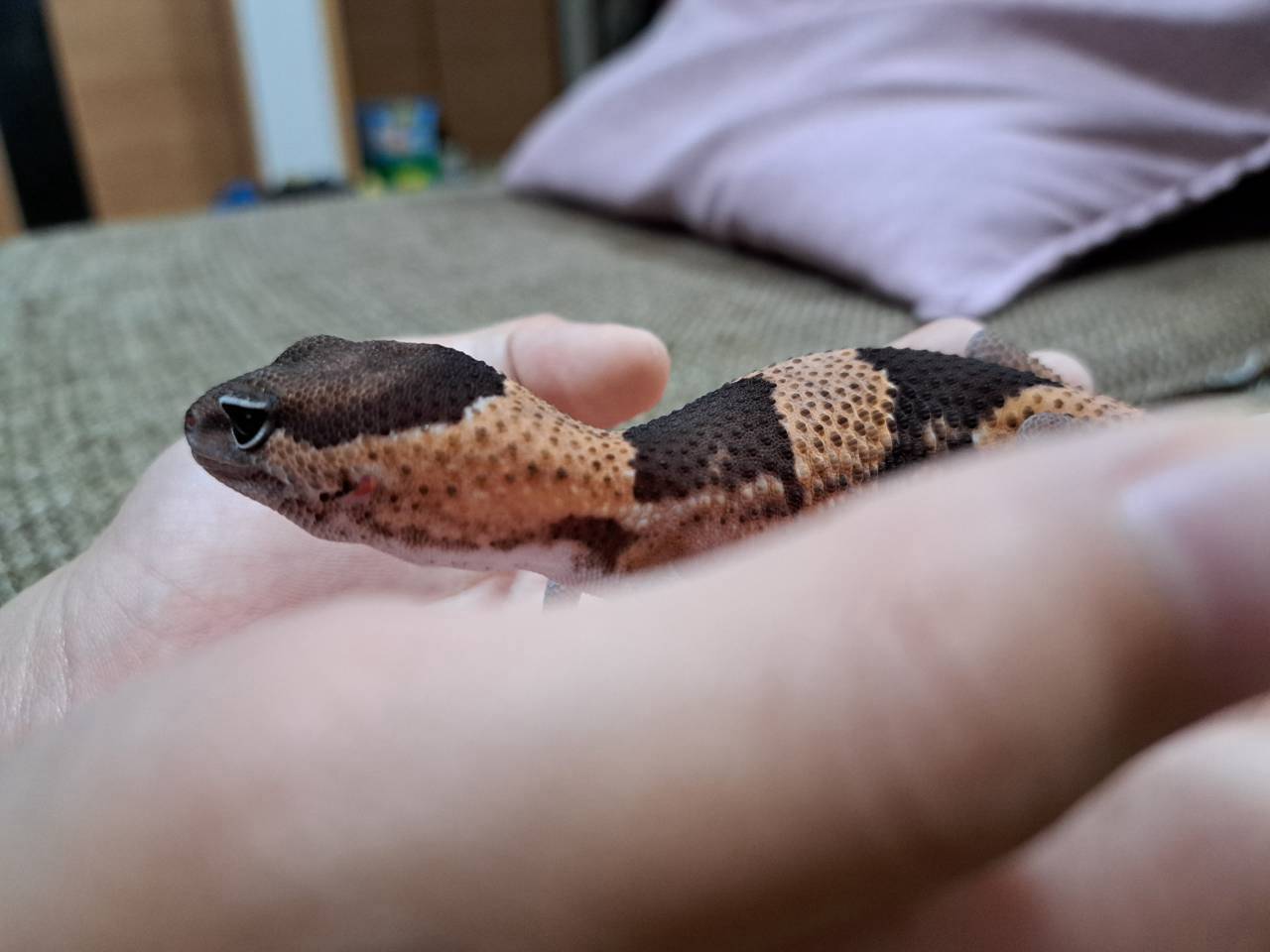
I keep Ohagi, an African fat-tailed gecko, at my home in Japan. Every photo here was taken in my home. Written from my own notes and photos, with AI helping me put it into English.