I Wanted an Oreo. We Brought Home the Gecko My Kid Fell For. Four Months Later, Here's How I Feel
"Which morph should I get for my first fat-tailed gecko?" The textbook answer is well established: pick a healthy animal, not a morph. I agree with it. But if there's a morph you've got your heart set on, that answer doesn't really help you.
So let me come clean: I wanted an Oreo. That black-and-white cookie look. What came home with us was Ohagi, a Normal. This post is about how that happened and how I feel about it four months in. The short version: we didn't choose by morph. We chose the gecko my kid fell for. I don't see many people writing about what happens after a choice like that.
1. I wanted an Oreo
When I decided on a fat-tailed gecko, the one in my head was an Oreo. The morph that grows into that crisp black-and-white look as an adult. Every photo I saw, I thought, "that one."
Normals (the regular banded coloring) honestly looked, well, normal to me. Brown base, dark bands. Like the illustration in a field guide. Nothing wrong with it, but not something you'd go out of your way to pick. That's what I thought at the time.
2. What happened at the store: no Oreo, and my kid decided
Looking back, that wasn't a bad way to decide. I was looking at a morph. My kid was looking at the animal. You don't live with a photo; you live with the one gecko in front of you.
3. Then I read the card: "het Oreo"
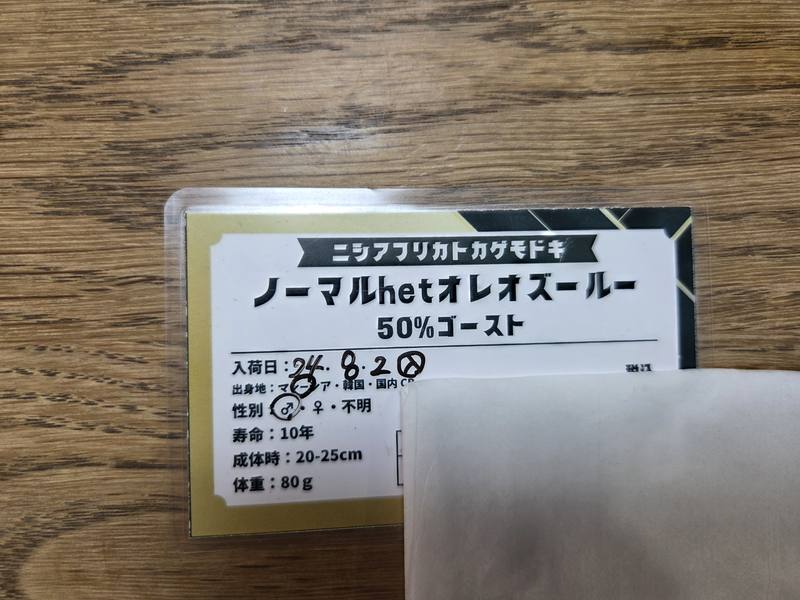
The card that came with Ohagi: "Normal het Oreo Zulu 50% Ghost." The word Oreo was right there
The card from the store read "Normal het Oreo Zulu 50% Ghost." Het means a hidden copy. Ohagi looks like a Normal, but somewhere in his genetic blueprint he carries one hidden copy of Oreo (there's a whole post on what het means).
So my Oreo wish was half granted. It doesn't show. But if he's ever paired with an Oreo female, half the babies would be Oreos, on paper. I didn't understand any of that at the time. Now that I can read the card, that hidden copy makes me a little happy.
One more thing about the card: the "80 g" on it was an expected adult weight. When I weighed him at home that day, he was 24.2 g. A card is easy to misread if you don't know the conventions. When in doubt, ask the staff.
4. What to check on a first gecko, if not the morph
This is the general advice, alongside what we actually did.
| What to look at | What you're checking | What we did |
|---|---|---|
| Tail | Is it thick? The tail is the gecko's savings account. A thin tail means he isn't eating, or isn't well | Both geckos had solid tails (even a beginner could see that) |
| Eyes, mouth, toes | Clear eyes, no crust around the mouth, no stuck shed on the toes | Honestly, I didn't know to look, so I didn't. I just trusted the store. Today I'd check every time |
| Weight | Ask them to weigh him if you can. The number on the card may be a target, not a measurement | Not weighed at the store. Weighed at home: 24.2 g, nowhere near the 80 g on the card |
| Size (age) | Babies need daily feeding. For a first gecko, a juvenile or older is easier | Narrowed it down to juveniles on the staff's advice |
| Captive bred? | Less parasite risk than wild-caught | The store's animals were captive bred |
| The store itself | Do they answer questions? Will they take the animal out for you? | They brought out three and answered everything. Glad we went there |
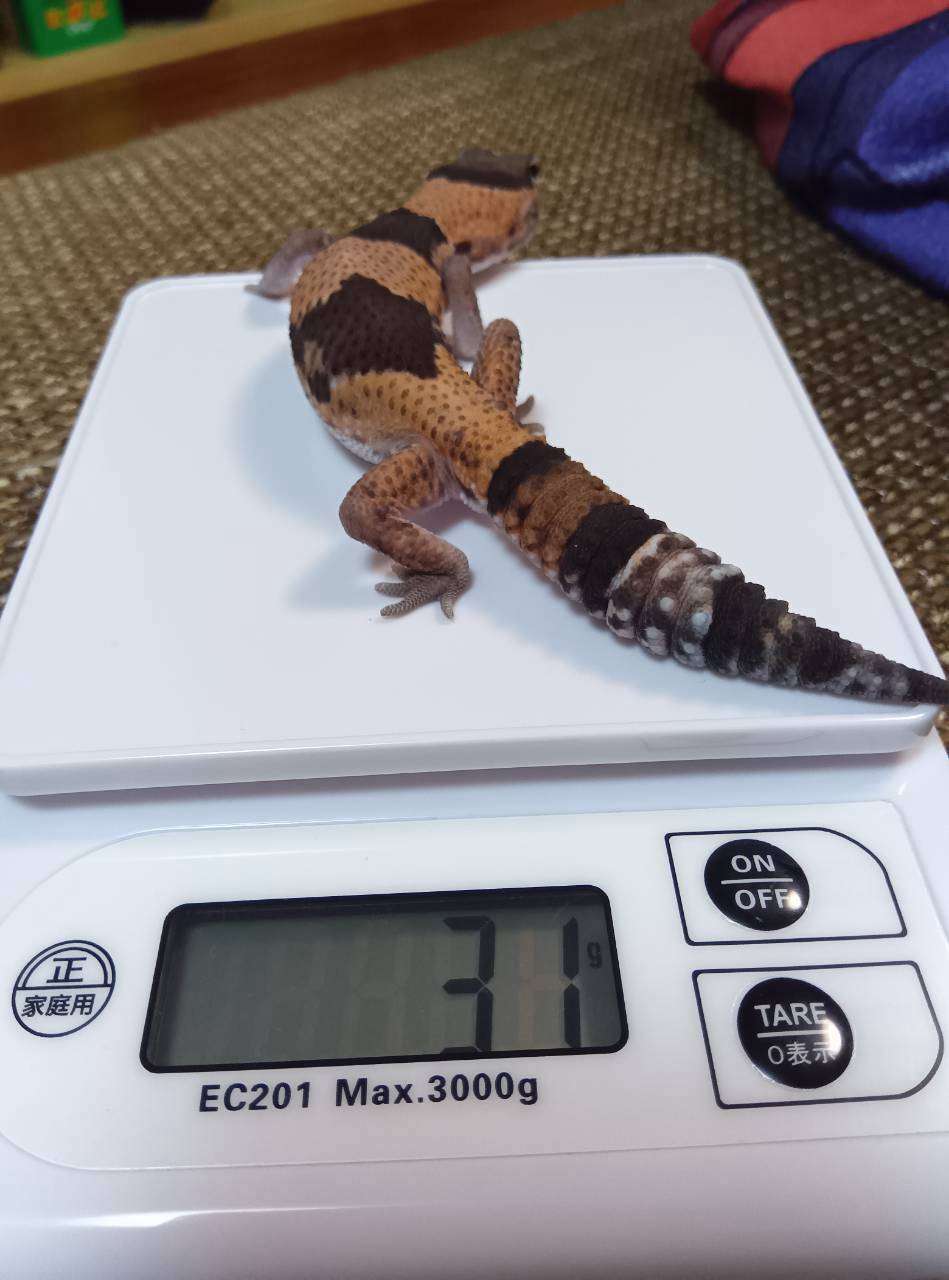
Tail thickness is the balance in the savings account. Check it at the store, and check it every day at home
5. What's been good about a Normal (four months in, honestly)
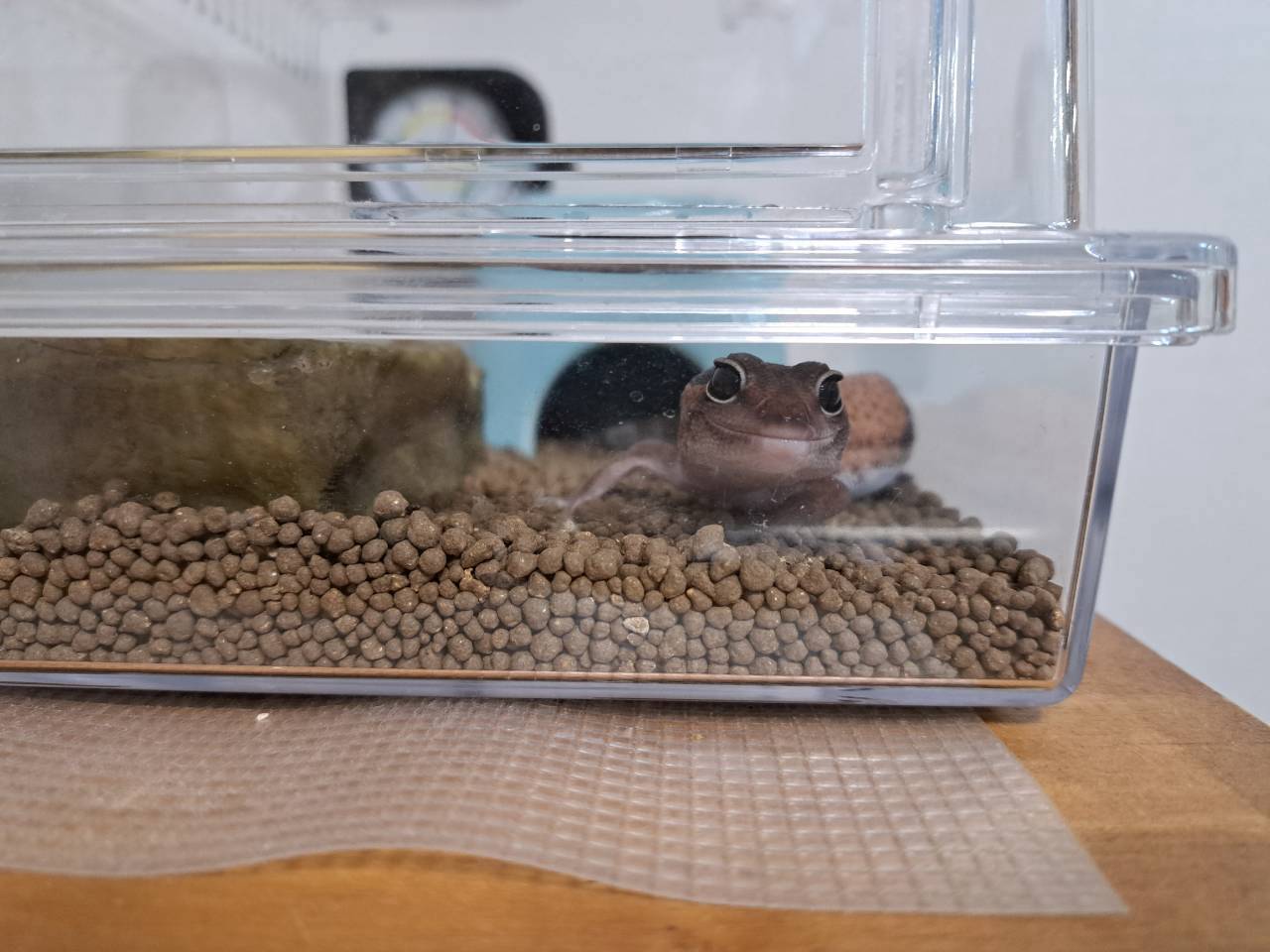
Ohagi at four months. The pattern I once called "just normal" is now the face I know best
- The bold pattern makes changes easy to see. Before a shed, his body goes cloudy white, and those dark bands make it obvious. I'm told that's harder to spot on the lighter morphs.
- A gecko the kid picked is a gecko the whole family loves. If it had been the Oreo I picked, he'd probably have been my gecko and nobody else's. The one who said "this one" still helps with every weigh-in.
- Thanks to the het, the Oreo is "in there." It doesn't show, but it's in the blueprint. Since learning that, his normal coloring doesn't look plain to me anymore. It looks like a color with something hidden in it.
There hasn't been a single moment in four months when I thought, "I wish he were an Oreo." We stopped choosing from photos and chose the one gecko in front of us, the one our family fell for. That's all it was, and I wouldn't choose differently.
6. If there's still a morph you want
Wanting a specific morph isn't a bad thing. I still love Oreos. All I'd suggest is getting the order right.
- If nobody nearby has it, don't rush to buy online. Seeing the animal in person and checking the tail, eyes, and toes yourself leaves you with fewer regrets.
- "Het" is another way to get there. A gecko that looks Normal but carries the morph you want is far more attainable than a visual one. And it gives you something to look forward to.
- Get the morph with your second gecko. Learn to keep one first, then go looking. That's my plan: an Oreo female, someday. And when that day comes, I'm buying a second enclosure.
FAQ
- Normals are cheaper. Does that mean they're weaker?
- Not at all. Price tracks how rare a morph is, not how healthy the animal is. If anything, given that albino-type morphs are said to be light-sensitive, a Normal is the closest thing to the "stock" gecko.
- Does the morph change how hard they are to keep?
- The basics are the same. The commonly cited differences are that albino types have light-sensitive eyes, and that pre-shed cloudiness is harder to see on lighter morphs. That's about it.
- Is it okay to let a kid choose?
- If an adult does the health check first, I think so. That's what we did. "I picked him" carries over into the daily care.
- Will the store know what I mean if I say "het"?
- Yes. "Do you have anything het Oreo?" is a perfectly normal question. Some stores put it on the card; at others you have to ask.
• Primary source: my own records for Ohagi, May–September 2026. The health checklist in section 4 is general husbandry knowledge; the "what we did" column is what actually happened, including what I skipped
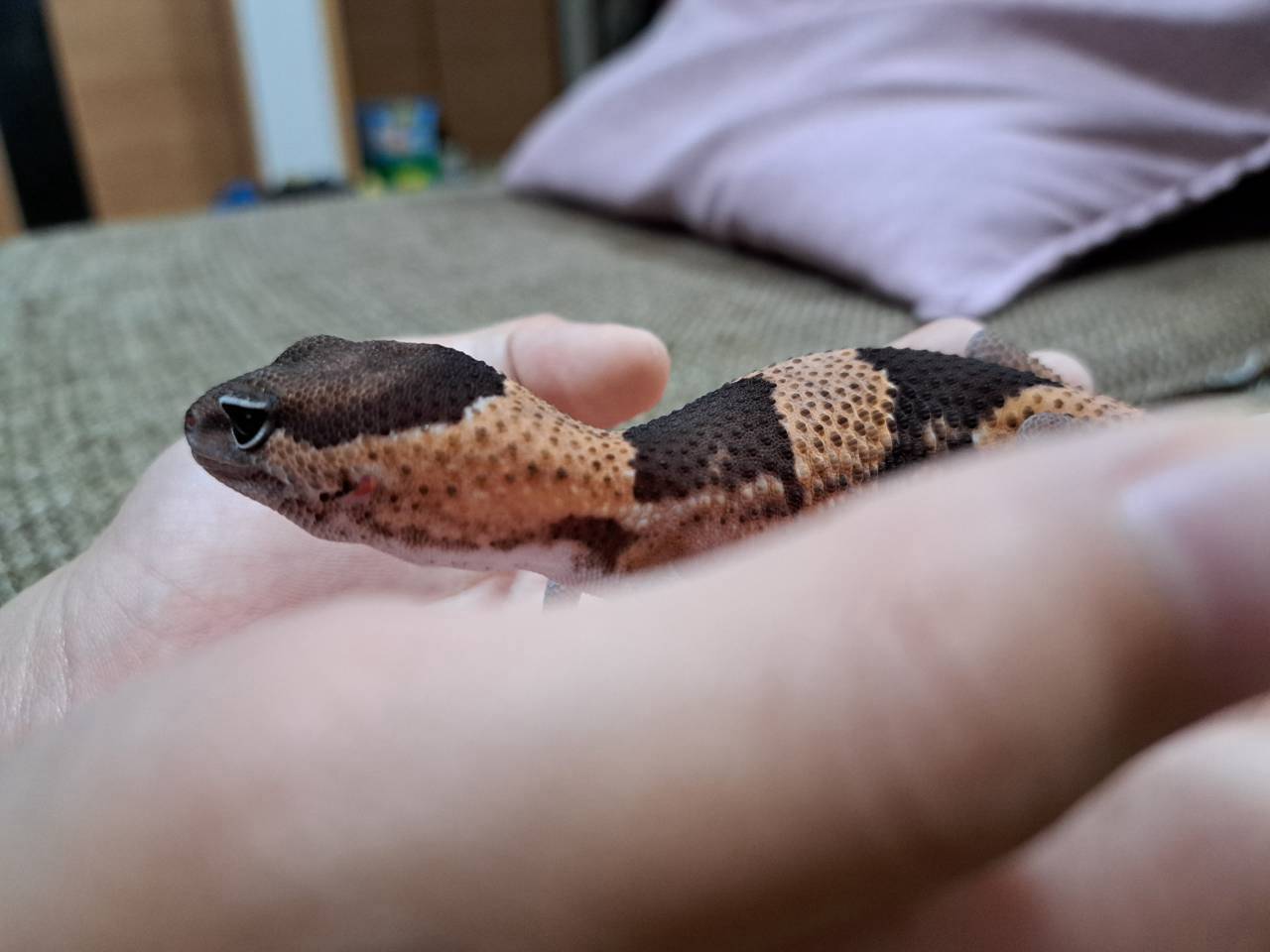
I keep Ohagi, an African fat-tailed gecko, at home in Japan. Every photo here was taken at our house. Written from my own notes and photos, with AI helping me put it into English.