Heat Mat or Heat Lamp for a Fat-Tailed Gecko? Four Months on a Mat Alone, No Lamp
Almost everyone who gets a fat-tailed gecko runs into this question early: is an under-tank heat mat enough, or do you also need a lamp overhead? In Japan, pet stores tend to recommend both. In the US, beginner kits usually come with a lamp. On the forums you'll find a "mat is plenty" camp and an "overhead heat is more natural" camp, and lately the second one seems to be louder.
Let me say it up front: my gecko Ohagi has one under-tank heat mat and nothing else. No lamp, no overhead heater. From May through September, his sheds, weight, and poop have all been fine. But I want to be honest about the catch: I haven't done a winter yet. I can't tell you a mat alone works year-round, because I don't know. This article covers my setup, where a mat-only approach falls short, and what I plan to do when it gets cold.
- UsingUnder-tank heat mat. Mine is a Japanese one called "Pitari Tekion Plus No. 2," a thin film-type mat about 9 × 9 inches (22 × 22 cm). In the US, any under-tank heat mat will do the same job
- UsingAnalog thermometer/hygrometer, the kind that sticks to the enclosure wall
- Not usingHeat lamp, ceramic heat emitter, any overhead heater, thermostat
- Considering for winterA no-light overhead heater. In Japan the standard one is a ceramic-style panel called "Dantotsu" that mounts to the enclosure ceiling
• Summer (June–September): the room climbs past 86°F (30°C) on its own and humidity hits 80%. I keep the room around 77°F (25°C) with air conditioning. Heat, not cold, is the problem.
• Spring and fall: room temperature sits around 68–77°F (20–25°C). Warm the floor with a mat and the air takes care of itself.
• Winter (December–February): most Japanese homes heat one room at a time, not the whole house. Once the heater is off for the night, a room can drop into the 50s (10–15°C). I haven't kept a gecko through this season yet.
If your home has central heating that holds 65–70°F (18–21°C) all winter, your conditions are easier than a Japanese winter. If the enclosure sits in an unheated room or a basement, my spring-through-fall experience doesn't transfer. Whether a mat alone is enough depends on the room, not the equipment.
1. Mat vs. lamp: what's actually different
Both are heaters, but they heat different things.
| Under-tank heat mat | Lamp or overhead heater | |
|---|---|---|
| What it heats | The floor. Warmth comes up through the belly | The air, and whatever surface the light hits |
| Light | None | Lamps, yes. Ceramic emitters, no |
| Air temperature | Barely changes | Goes up |
| Humidity | Barely changes | Tends to drop (dries the air) |
| Best for | A room that's already reasonably warm. Belly heat for digestion | A cold room. Raising the whole enclosure's temperature |
Fat-tailed geckos are nocturnal. In the wild they spend the day under rocks and in burrows. They aren't animals that bask under the sun; they're animals that absorb the heat of sun-warmed ground through their bellies. So a device that warms the floor lines up with how the animal actually works. The way I think of it, a lamp is a backup for when the room is so cold the whole enclosure goes cold, not the main event.
2. My setup: where the mat goes and how
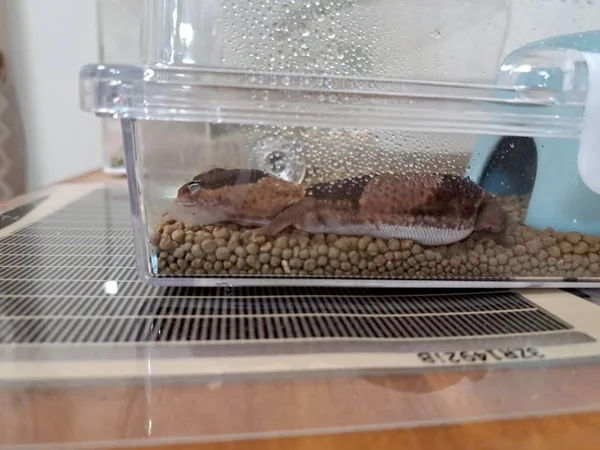
This is the entire heat source: a thin mat slid under the enclosure. It's about an eighth of an inch (a few millimeters) thick and gives off no light
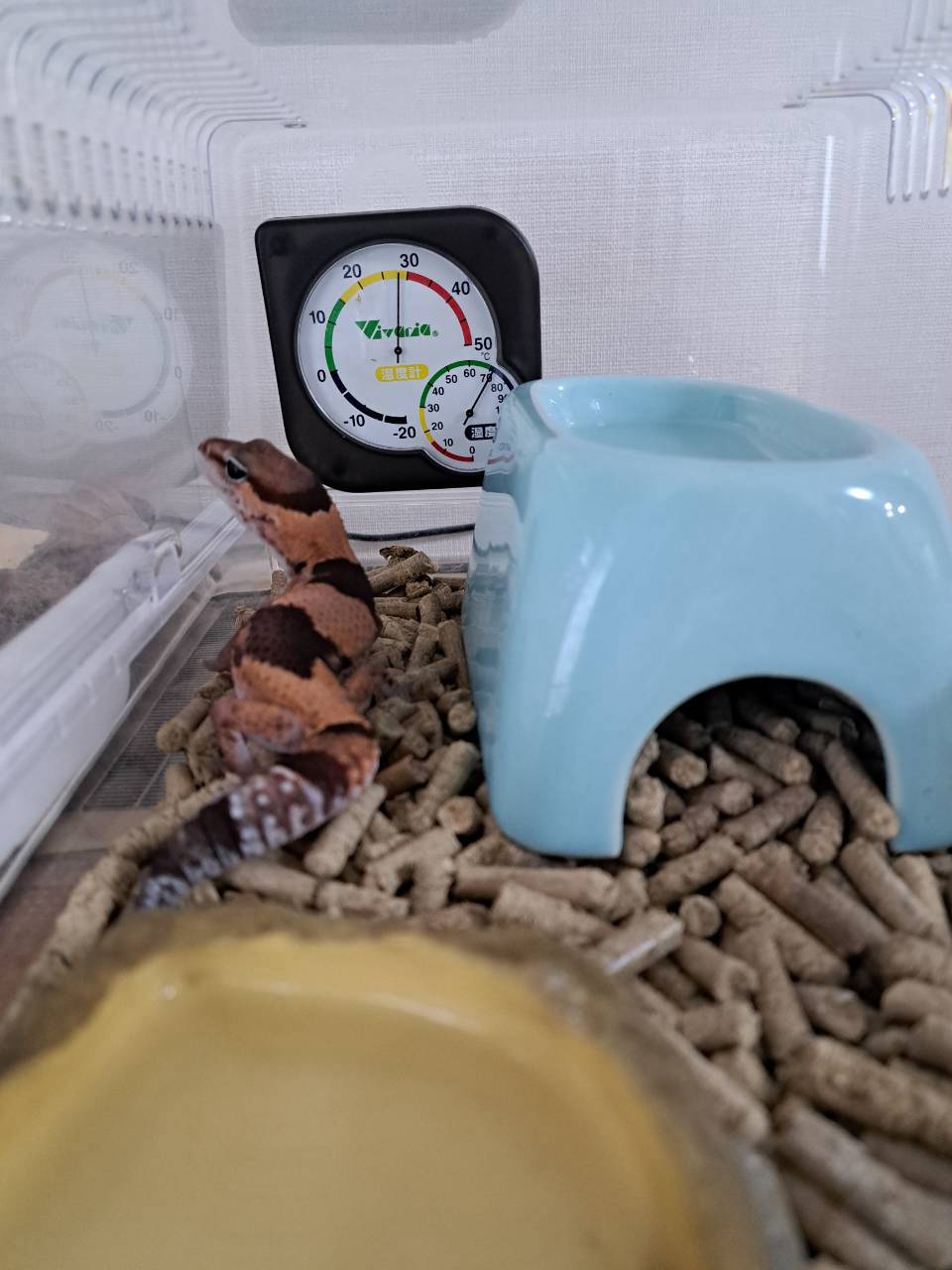
A summer-day reading: a little under 86°F (30°C), humidity around 70%. It's stuck to the warm-side wall
With this layout, Ohagi's day goes like this. On a comfortable day he sleeps inside the hide. On a hot day he comes out and stretches across the unheated side of the floor. On a really hot day he climbs onto the water dish on top of the hide. Give him a warm side and a cool side, and he picks. Cover the whole floor with a mat and he can't pick anymore, which is why "half" matters.
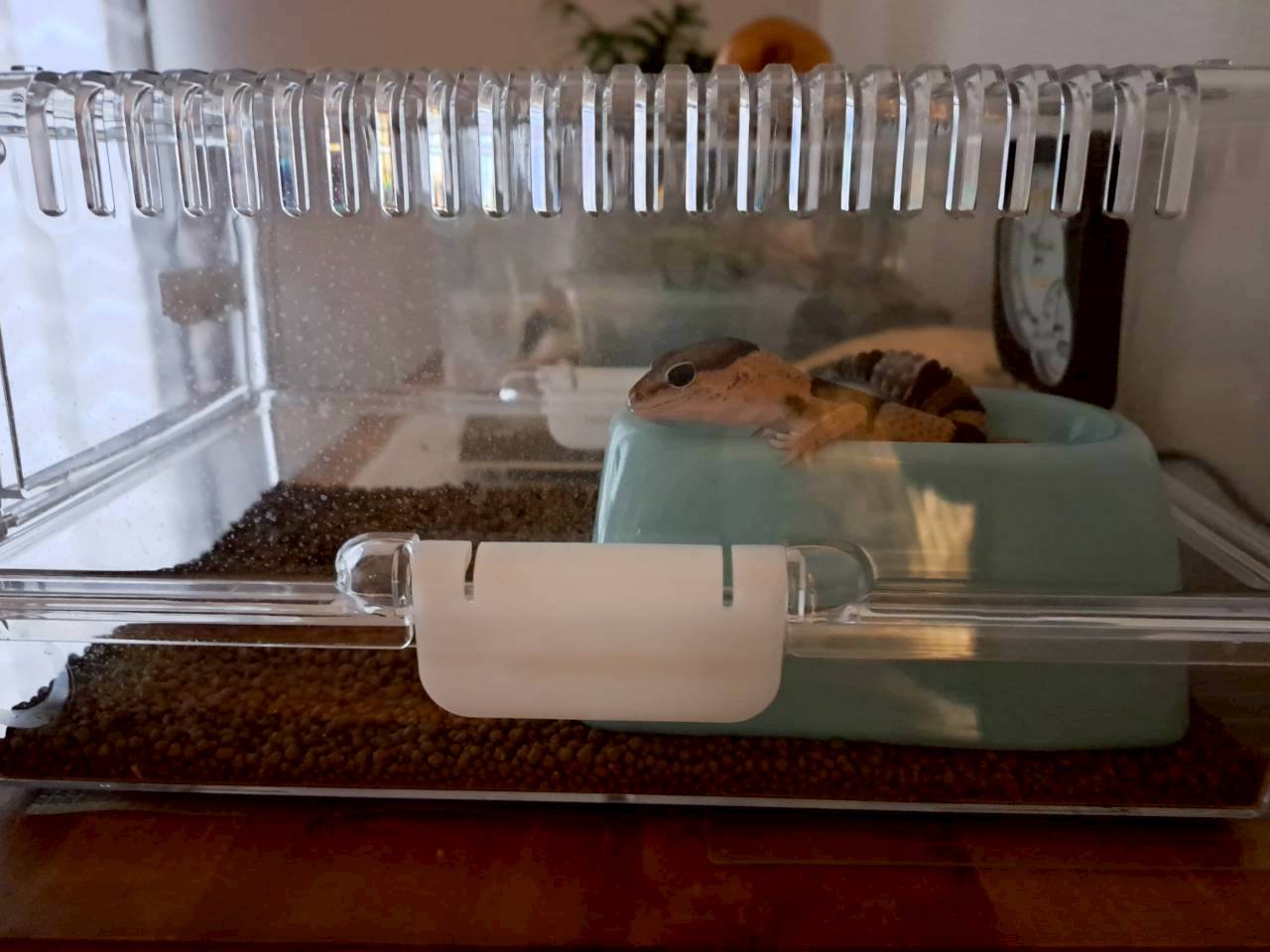
On a hot day he climbs onto the water dish on top of the hide, which sits on the heated side. As long as there's somewhere to go, he does the fine-tuning himself
3. Why I don't use a lamp
- He's nocturnal, and bright light stresses him. Fat-tails spend the day hidden. A bright lamp turns everything outside the hide into a place he'd rather not be.
- Lamps dry the air. Fat-tails like 60–70% humidity. Overhead heat pulls humidity down, and that shows up in his sheds. I keep humidity up with misting and a ceramic moist hide; I don't want a device working against that.
- The enclosure is small. Put a lamp over a 12-inch (30 cm) enclosure and there's no cool side left. To me, a lamp only makes sense in a bigger enclosure, where there's room for a real gradient.
- In a Japanese home, the air rarely needs heating outside of winter. From May through September, room temperature alone was enough. That's a fact about where I live, and it's what the next section is about.
UVB lighting is a separate question from heat. Whether a fat-tail needs it gets its own article.
4. Where a mat alone falls short (no hiding this part)
I said a mat alone has worked. That was in Japan, May through September, in a room that sat around 77°F (25°C). Change the conditions and a mat stops being enough.
| Weakness | What happens | In my case |
|---|---|---|
| It doesn't heat the air | In a cold room, the floor is warm but the air is cold. If the room drops below 68°F (20°C) at night, a mat alone leaves the whole enclosure chilly | Hasn't come up spring through fall. Winter is unknown (section 6) |
| It heats a small area | Only the floor above the mat is warm. In a big enclosure the warm zone shrinks to a single spot | Not an issue at 12 inches. I'll rethink it when he moves up to a bigger enclosure |
| It can overheat | Depending on the product and setup, the floor surface can pass 104°F (40°C). More likely with a glass bottom, deep substrate, or a tightly sealed enclosure. Burns from this are slow and hard to spot | No thermostat here. I cover half the floor for an escape route and watch the thermometer. A thermostat is the correct safety answer, and I know it |
| Thick substrate blocks the heat | Pile the soil deep and the surface goes lukewarm | My soil is about an inch (2–3 cm). The surface warms through at that depth |
5. My mistake: running the mat by feel
Not long after he came home, I was switching the mat on and off based on how the room felt to me. "It's warm today." "It's hot today." During a stretch when I had it off, his appetite dropped noticeably and his poop went loose. When I checked the thermometer, the floor was cooler than I'd assumed. How warm a room feels to a human and how warm the floor is are two different things.
I turned the mat back on and his appetite and poop went back to normal almost immediately. Since then the mat stays on by default. I only turn it off on days when the thermometer is already high or the forecast says it's going to be. Check the numbers first; don't wait for him to tell you something's wrong.
A mat-only setup has exactly one piece of equipment, and if you run that one piece on how you happen to feel that day, the gecko feels it fast. "Mat or lamp?" gets the attention, but in practice "is it on, or did I turn it off?" is the far more common failure.
6. What I plan to do about winter
Honest answer: I don't know yet. Ohagi came home in May, so he hasn't seen a winter with me. A lot of rooms in Japan drop into the 50s (10–15°C) in winter, and I think there's a good chance one mat won't warm the air enough.
The plan is to keep the mat and add a no-light overhead heater. In Japan the standard one is called "Dantotsu," a ceramic-style panel that mounts to the enclosure ceiling. In the US, a ceramic heat emitter (the no-light kind) or a radiant heat panel does the same job. Either way, overhead heat dries the air, so I'll be watching the hygrometer and misting more.
Once it's in, I'll measure the temperature before and after and add the numbers to this article. Whether the result is "one mat got him through winter" or "no way, I had to add heat," I'll write it up.
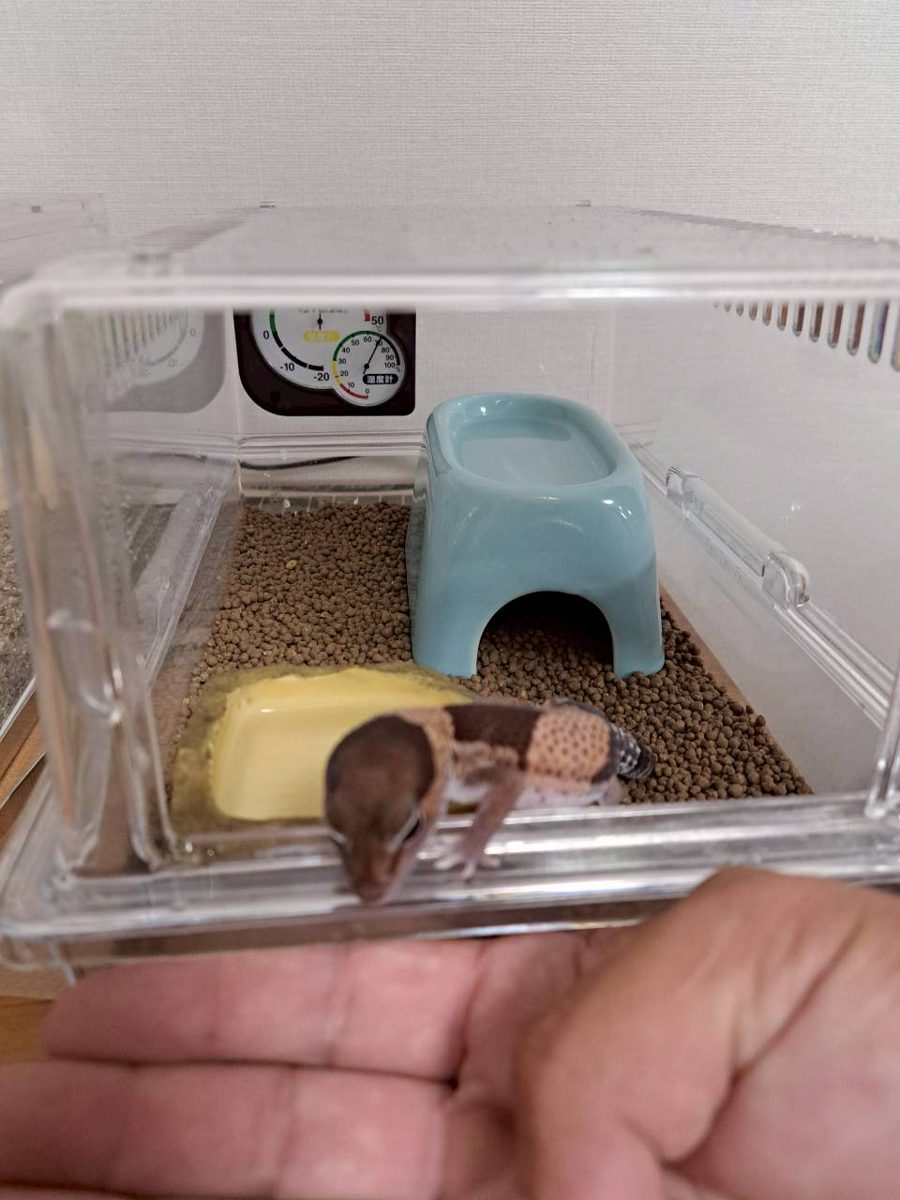
The enclosure today. Nothing overhead yet. An overhead heater is going in before winter
FAQ
- Do you turn the heat mat off at night?
- No, it stays on. Fat-tails are active and eat at night, so that's when they need a warm floor for digestion most. Through summer it stays on except on days when the room is already hot. I'll admit I've never measured the floor temperature on a summer night, so I can't give you that number.
- Is it really okay without a thermostat?
- I've had no problems in four months, but that may just mean my conditions happened to line up. I cover only half the floor, keep the substrate from getting too thin (a thin layer runs hotter), and watch the thermometer. If you're starting out, I'd get a thermostat. It's cheap, and it shuts the mat off before the floor gets too hot instead of leaving that to you.
- What about heat rocks?
- I don't use one and don't plan to. The rock itself gets hot, and a gecko that sits on it and doesn't move is at real risk of a burn; that's the widely repeated warning. An under-tank mat makes it much easier to leave him an escape route.
- Does the mat go inside the enclosure or under it?
- Under it. Inside, the gecko can touch it directly and it gets too hot, plus it gets hit with water and urine. My thin film mat just slides under the enclosure; setup took seconds.
- So are people using lamps doing it wrong?
- Not at all. In a cold home or a large enclosure, the whole thing goes cold without a lamp or overhead heater. It isn't "which is right," it's "what do your room temperature and enclosure size call for." Mine has gotten by on a mat because of a small enclosure and a warm season, nothing more.
• Primary source: my own setup and records for Ohagi, May–September 2026. Target temperatures and the mat-vs-overhead comparison are general husbandry knowledge; the note about US keepers' preferences is my reading of English-language guides and forums, not a survey
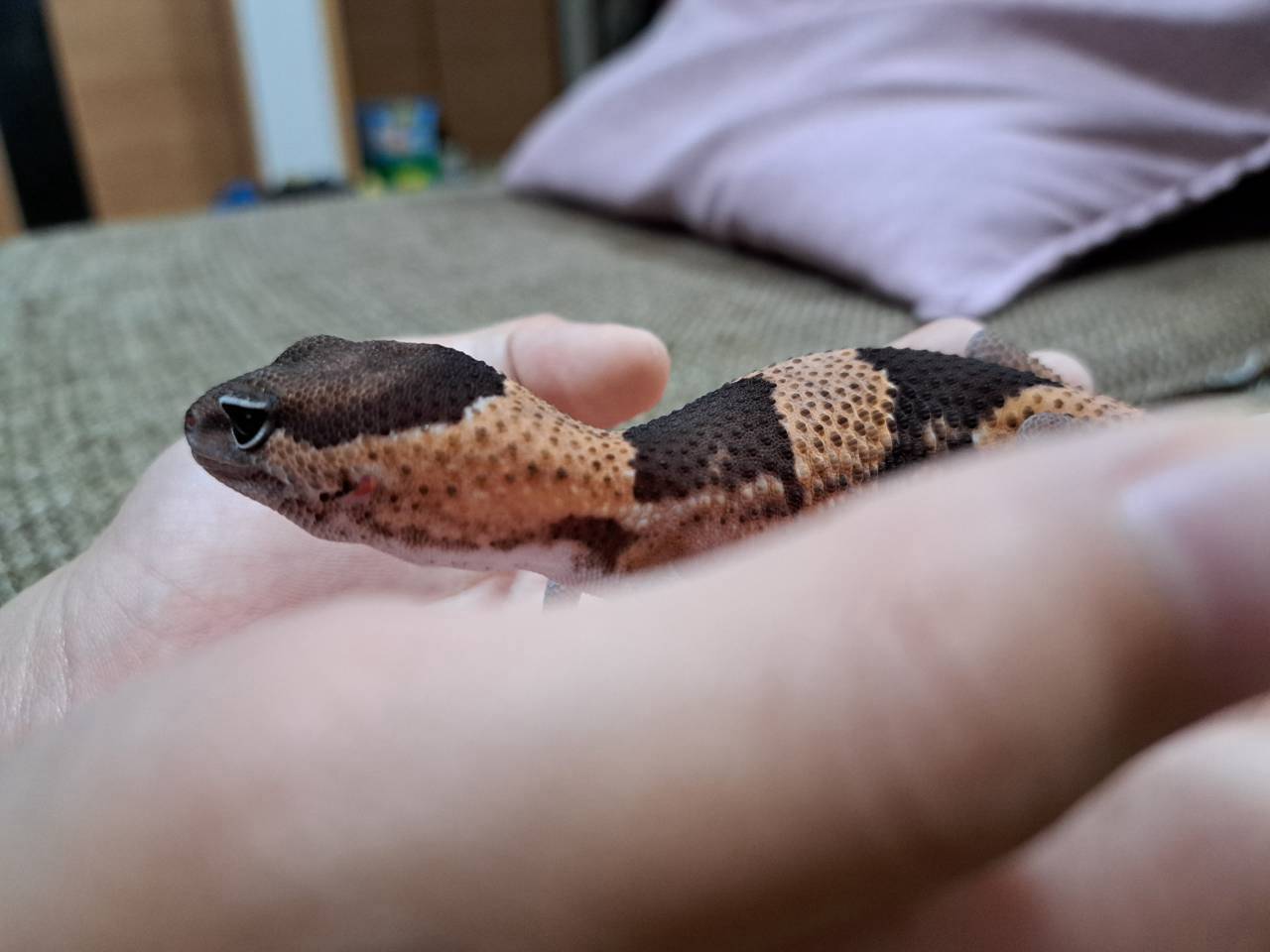
I keep Ohagi, an African fat-tailed gecko, at my home in Japan. Every photo here was taken in my home. Written from my own notes and photos, with AI helping me put it into English.