
Does My Fat-Tailed Gecko Know Me? Four Months of Getting Closer (It's "Used to You," Not "Bonded")
Once you've kept a gecko for a little while, almost everyone ends up asking: "Does he know it's me?" He walks over when I open the door at night. He flicks his tongue near my hand. Watch that a few times and you really want to believe he's figured out who you are.
Let me be honest up front: I don't know whether Ohagi can tell me apart from anyone else. What I do know is that his behavior changed clearly over four months. This post lays out that change as a timeline, then separates what I can actually claim from what I can't. If you're hoping for "bonded," this post may feel a little cold. What you get instead is a real example of what "used to you" looks like.
1. Four months of change, in order
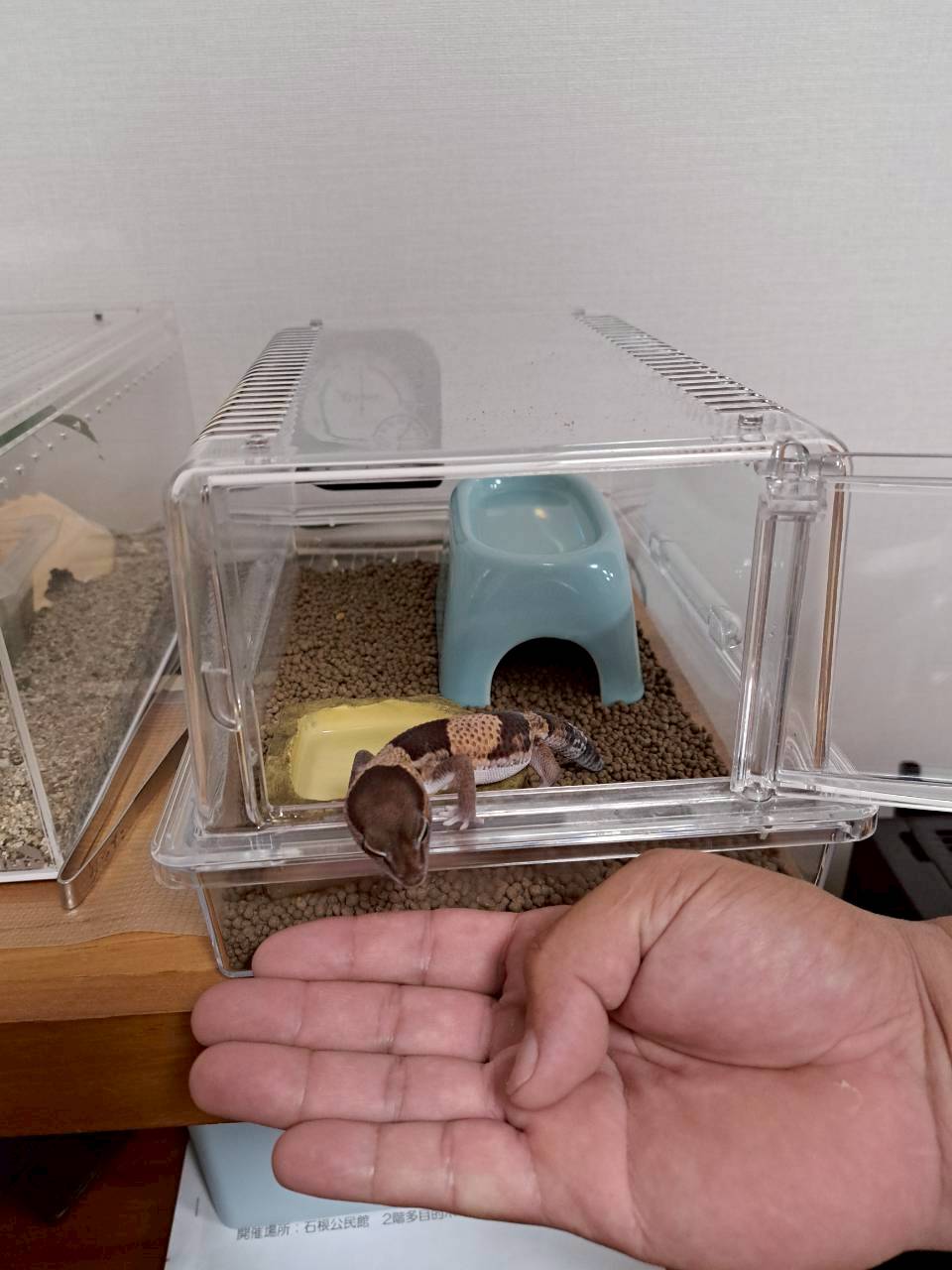
The night of July 2. I opened the door and out he came. Two months in, and this is how far we'd gotten
Lined up like that, what changed isn't really his attitude toward people. It's his reaction to the door, the food, and the time of night on feeding days. What Ohagi learned, I suspect, isn't my face. It's that set of three.
2. What I can say he's learned, and what I can't
| What I can say | Why |
|---|---|
| "Door opens = food" is firmly learned | Open the door at night and he walks over almost every time. Right after he came home, that number was zero |
| "Tongs and dish = bugs" is learned too | The instant he sees food, the reaction is the same every time |
| A human hand is no longer something to fear | Tongue flicks near my hand. Doesn't run. Occasionally climbs on |
| He knows the time of night | Open the door in the daytime and none of this happens |
| What I can't say | Why |
|---|---|
| That he tells me apart from other people | No matter who in the family opens the door, the reaction is the same. When someone outside the family opens it, it doesn't change much either |
| That he comes out because he wants to see me | He comes out at feeding time. In the daytime, with no food involved, he doesn't |
| That he likes being on my hand | He climbs on only now and then, and doesn't stay long. "Doesn't mind it" is the honest way to put it |
So: not "bonded," but "used to me." In human terms that sounds a little sad. From the gecko's side, it's a big change: this place is safe, and food shows up at this time.
3. How geckos see people (the general view)
This section isn't my own observation. It's the general view among keepers.
- They learn what's "normal" through scent, vibration, and routine. Rather than recognizing a face, they're thought to learn the combination: at this time, this sound happens, this smell approaches, and food arrives. I think Ohagi's tongue flicking is him checking that smell.
- They size people up on two things: safety and food. A person who doesn't do scary things, plus a person who brings food, equals someone it's okay to approach. The dog-and-cat kind of "I want to be with you" is generally thought to be almost absent in reptiles.
- Trust builds slowly and collapses fast. Grabbing from above, chasing, dropping. One bad experience and they go back to being wary for a while, or so keepers commonly say. Avoiding that was my top priority (next section).
4. What I did to get him used to me, and what I didn't do
| What I did | Why |
|---|---|
| Feed every three days, at the same time of night | So he'd learn "door opens at this time = food." On non-feeding nights I don't open the enclosure at that time just to check on him (I think doing that every night would only stress him) |
| Change the water daily, quickly. Remove poop when I spot it | Keep my hands in and out as little as possible. A few seconds through the small side door |
| Reach in through the side door, never from above | A shadow from above is a predator's shadow. Coming in from the side startles him less |
| Insects come from tongs or a dish; mealworms sometimes from my hand | So a human hand becomes "where food comes from" |
| Whether he climbs on is up to him | On days he doesn't, I don't put him on my hand. No picking him up against his will. |
| Put him back the moment he shows he's had enough | Tail waving, going stiff, trying to get away: that's my cue to stop |
| What I didn't do | Why |
|---|---|
| Handle him daily | Daytime is his sleeping time. Maybe once a week, a few minutes while cleaning or weighing him |
| Wake him up and take him out in the daytime | I didn't want "person = the thing that interrupts my sleep" |
| Grab from above | Not once. When I do pick him up, my hand slides in from below |
| Pet him or cuddle him | Geckos aren't thought to have the wiring for "that feels nice" |
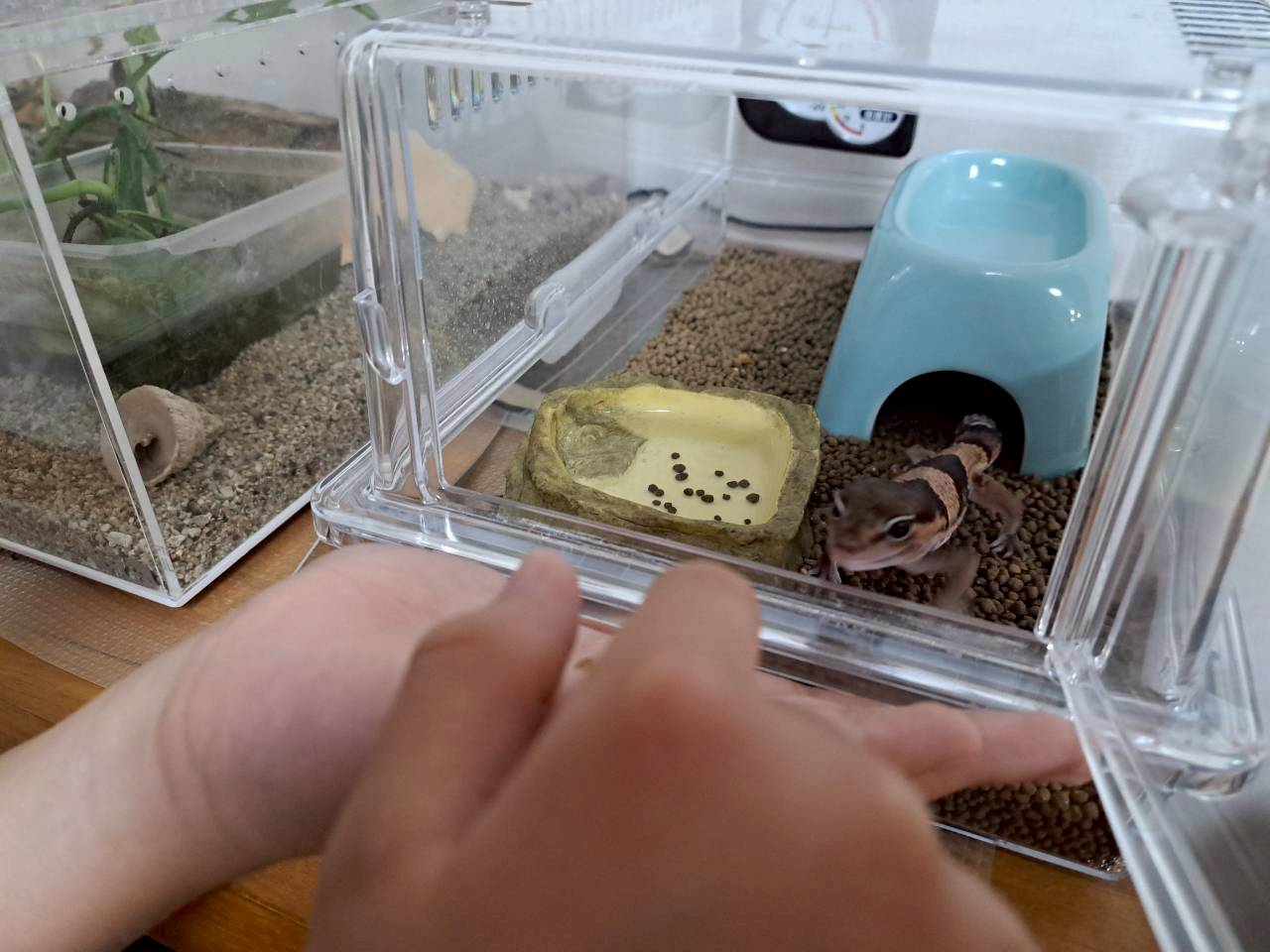
A mealworm from my hand. The first step toward a human hand meaning "where food comes from"
In the end, all I did was repeat the same routine and avoid anything unpleasant. No special training. Underneath it is one belief: the less you handle them, the faster they get used to you. I don't think more attention means faster progress. Daily care means my hands go in and out, but I keep it short and otherwise leave him alone. That got him to the door in two months, and tongue flicking next to my hand in four.
5. It goes better when you don't expect "bonded"
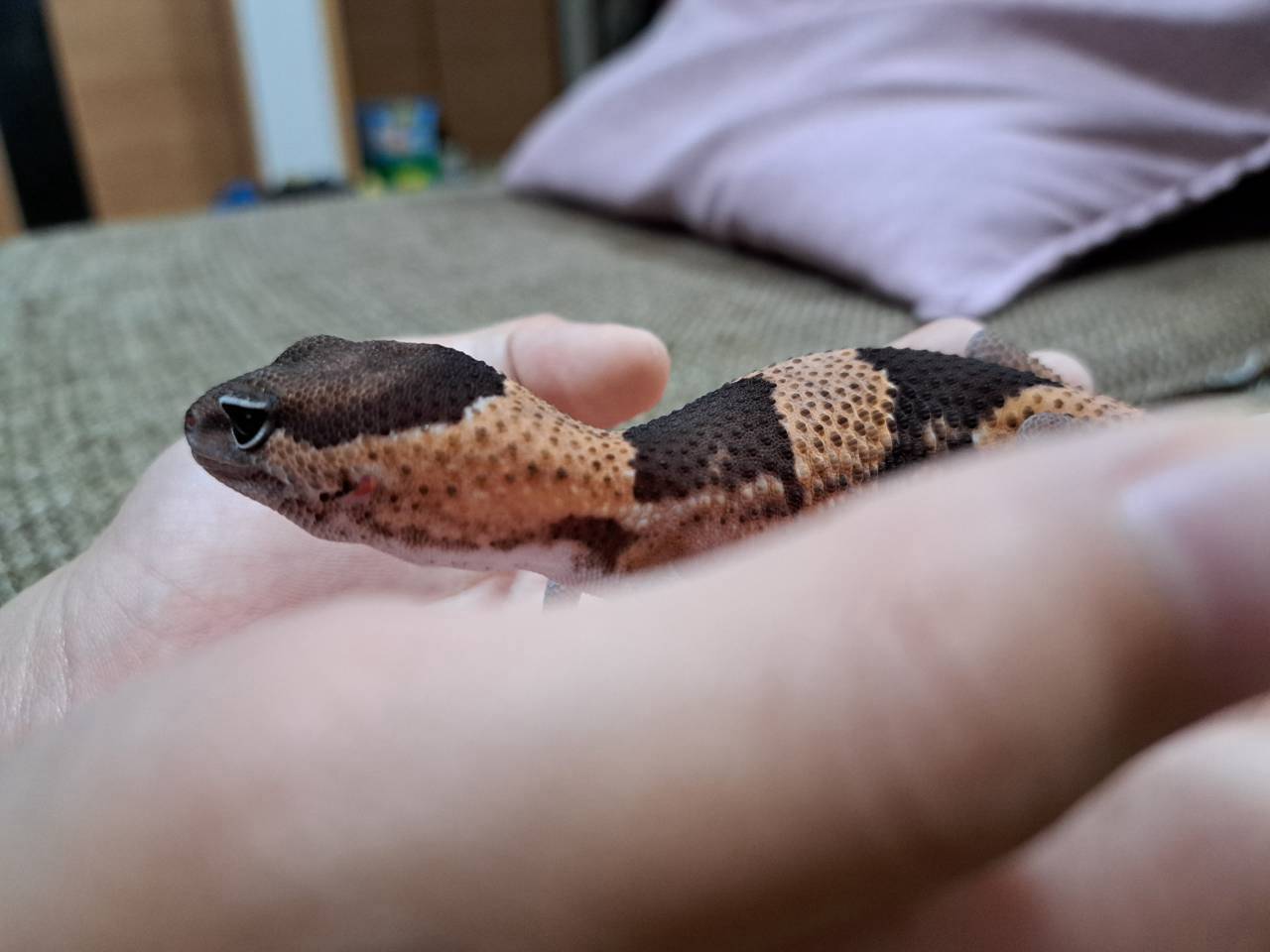
On my palm. When he does climb on: no running, no biting, just a slow shuffle. That's enough
Four months in, here's what I've come to think: the moment you want him to bond with you, you get impatient. Impatient means too much handling, the gecko goes back to being wary, and he ends up farther away than before. When I decided "used to me is plenty" and just kept repeating the routine, he was the one who closed the distance.
Whether Ohagi knows who I am, I'll probably never find out. But open the door at night and he walks over, flicks his tongue, and now and then climbs onto my hand. On the day he came home, I couldn't have imagined getting this close. These days, that feels like enough.
FAQ
- Do fat-tailed geckos bond with their owners?
- "Used to you" is closer to the truth than "bonded." They learn who's safe and when food comes, and they start coming over. They don't come looking for affection the way a dog or cat does.
- How long does it take?
- For us, about two months until he came to the door, about four until he was tongue flicking next to my hand. Individuals vary a lot, so treat that as a rough guide. For the first few weeks, staying hidden except at feeding time is normal. Ohagi only came out when I brought food.
- He won't climb onto my hand. Does he dislike me?
- Probably not. Whether he climbs on depends on his mood and the time of day. With Ohagi it's "now and then" too. If he doesn't run, and he approaches with his tongue flicking, you're making progress.
- Any tricks to speed it up?
- There's no shortcut. Same time of night on feeding days, reach in from the side, stop the moment he objects. Repeat those three. My own view is that less handling gets you there faster; I actually avoid opening the enclosure every night just to fuss over him. Try to "make friends fast" and he'll back off instead.
- Does he come when I call his name?
- Mine doesn't. He's responding to the sound of the door and the time of night, not to a voice. The name is for the humans.
• Primary source: my own records for Ohagi, May–September 2026. Section 3 is general husbandry knowledge about how reptiles respond to people, not something I found out myself
I keep Ohagi, an African fat-tailed gecko, at home in Japan. Every photo here was taken at our house. Written from my own notes and photos, with AI helping me put it into English.